Cemeteries
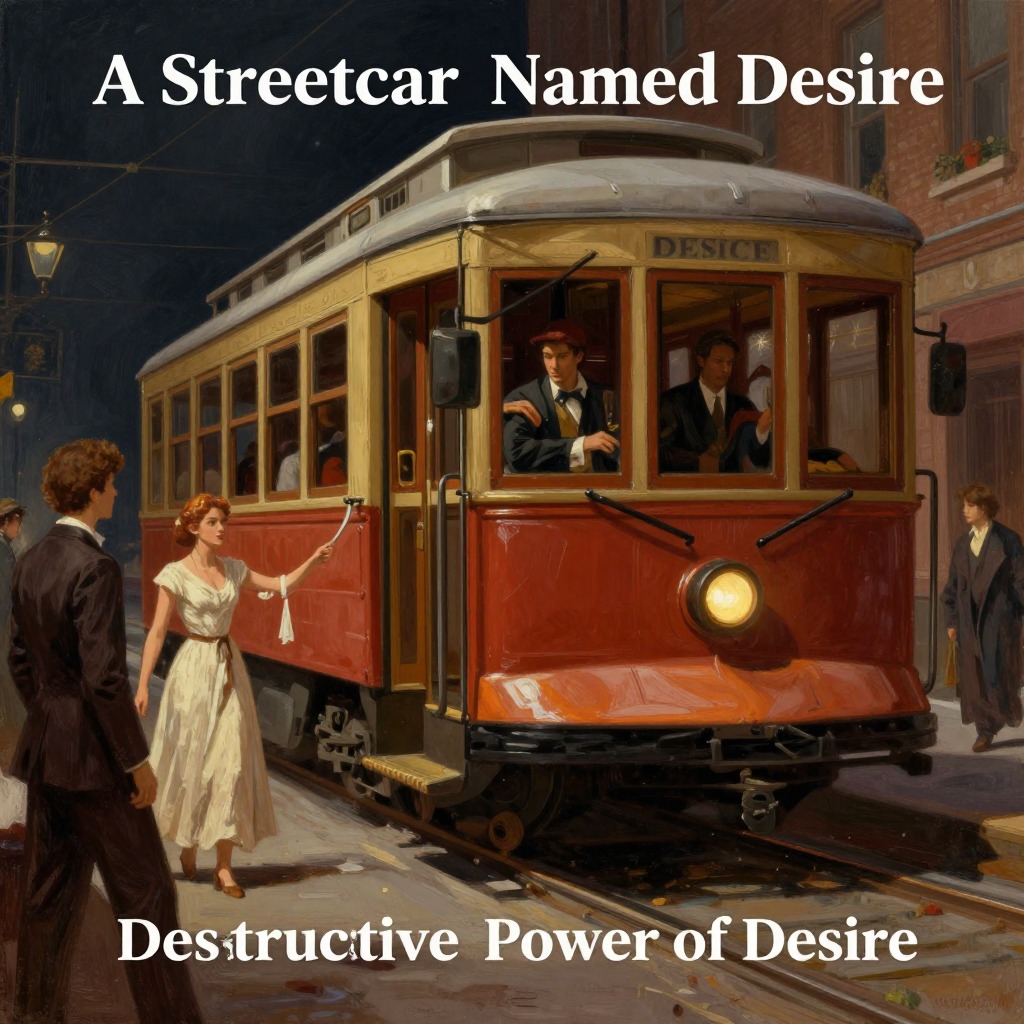
Cemeteries is the name of the streetcar line that Blanche DuBois must transfer to after riding the Streetcar Named Desire, completing her journey to her sister Stella Kowalski's home on Elysian Fields in New Orleans. The route is first mentioned by Blanche herself in Scene One, when she explains to Eunice Hubbell that she was instructed to "take a street-car named Desire, and then transfer to one called Cemeteries and ride six blocks and get off at—Elysian Fields!" This sequence of transit lines—from Desire to Cemeteries to Elysian Fields—encapsulates the play's central thematic arc, moving from passionate longing through death to a mythic afterlife, and it establishes the symbolic geography that Blanche will traverse over the course of the drama.
Symbolic Meaning and Thematic Function
The name "Cemeteries" carries an unmistakable association with death, and its placement in Blanche's journey links the raw, life-driven force of desire to its inevitable terminus in mortality. The play's language repeatedly reinforces this connection: Blanche later describes desire itself as "the opposite" of death, and the streetcar's name becomes a shorthand for the destructive consequences of unchecked passion. The route's destination, Elysian Fields—named after the Greek mythological afterlife for the blessed—completes the symbolic transit, suggesting that the passage through desire and death leads to a kind of final resting place. This symbolic geography is not merely decorative; it structures Blanche's entire narrative arc, from her arrival as a woman fleeing her past to her final removal from the Kowalski apartment, which she herself describes as a "trap."
Blanche's Journey and the Desire-Cemeteries Connection
Blanche's personal history is defined by the interplay of desire and death. Her young husband Allan Grey, whom she loved "unendurably," shot himself after she confronted him about his homosexuality, an event that haunts her throughout the play. The polka tune "Varsouviana" that played at the Moon Lake Casino on the night of his suicide recurs in her mind as a psychological trigger, and she drinks to escape it. In Scene Nine, when Mitch confronts her about her past, she explicitly connects the two poles: "Death—I used to sit here and she used to sit over there and death was as close as you are. . . . We didn't dare even admit we had ever heard of it!" She then adds, "The opposite is desire." This formulation directly echoes the streetcar route: desire and death are not sequential but opposite forces, yet the play's structure forces Blanche to travel from one to the other. Her own behavior—seeking intimacy with strangers after Allan's death, her affair with a seventeen-year-old student, her compulsive flirtation with the Young Collector—represents an attempt to fill the void left by death with desire, but the trajectory always leads back to the cemetery.
Thematic Significance and Narrative Role
The Cemeteries streetcar line functions as a structural and symbolic device that organizes the play's central conflict between illusion and reality, past and present, life and death. Blanche's refusal to accept the "realism" of her situation—her insistence on "magic" and her paper lantern over the bare light bulb—is a flight from the cemetery that awaits her. Stanley Kowalski, by contrast, embodies a brute, life-affirming force that ultimately destroys her. The play's final image, with Blanche being led away by the Doctor and Matron, echoes the journey she described at the beginning: she has ridden desire to its end and arrived at the cemetery, from which she will be taken to an institution—a kind of living death. The streetcar line thus serves as a unifying metaphor for the inescapable logic of the play: desire, pursued without restraint, leads to destruction, and the only escape is into the illusion of Elysian Fields, which for Blanche is the "kindness of strangers."